Small Steps, Not Big Rules: Innovative Rural Business Models for Your Small Town
I recently had the privilege of presenting to a statewide group of economic developers about Innovative Rural Business Models—what we call the “Tiny, Temporary, Together, Travelling, and Tech” models. These are creative ways for entrepreneurs to test business ideas without breaking the bank. Think of them as starter steps that lower the barrier to entry for anyone brave enough to start something new.
It was a virtual session, and the chat room lit up with questions about code enforcement, ordinances, insurance, and scaling. My first thought?
“Stop stomping on all the good ideas with your big-rule boots!”
Then I took a breath and remembered that I’m operating in the new way of doing things—while many others are still rooted in the old way. Or they are used to dealing with some old way folks, so they automatically still apply those ways.
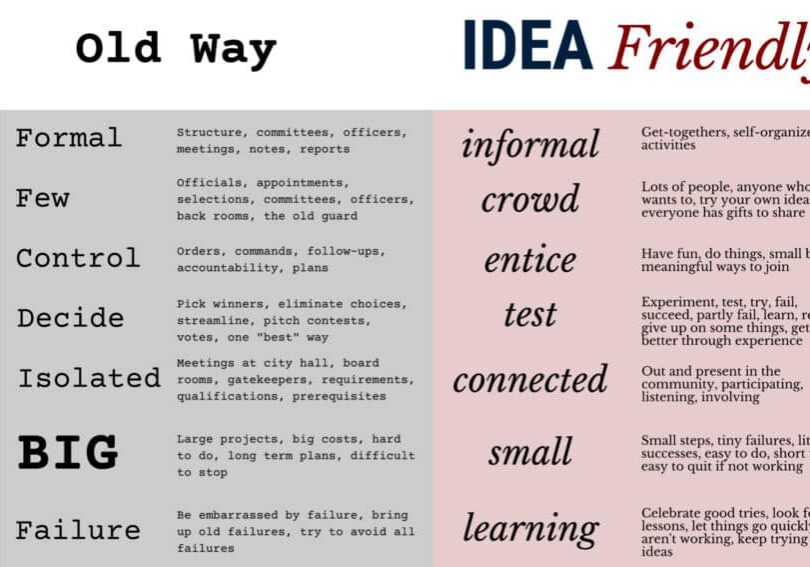
The Old Way
You probably know this one well:
- Everything has to be official, formal, and structured.
- Someone must be “in charge.”
- Meetings (so many meetings…).
- Decisions made behind closed doors.
- Big projects that take forever to start—and heaven forbid they fail.
So many of our towns still operate like this. Boards, committees, and endless decision-making cycles that squeeze out the “what if” ideas. Failure becomes taboo. And when things do fail, we point fingers instead of learning.
The New Way
The new way is faster, lighter, friendlier—and it’s already here.
- We gather informally.
- Chaos isn’t bad; it breeds innovation.
- Lots of people get involved.
- We try small things, test, learn, and adjust.
- We connect, collaborate, and keep taking small steps forward.
It’s not always easy to shift gears. Many of us are straddling both worlds—stuck between the “way we’ve always done it” and this exciting, experimental new approach.
Or as John F. Kennedy said, “Change is the law of life. And those who look only to the past or present are certain to miss the future.”
So, what were the big questions?
- What about permitting, sales tax, business licenses, and insurance?
Great question—and one that came up again and again. Here’s the deal: these models are small steps designed to test ideas. Pop-ups at an event, a shared storefront for a few months, or even just a shelf in another business count. When these ideas grow, that’s the time to handle the permits and licenses. The SBDC and your city can help with that. Maybe you even suspend a few rules short-term and see what happens! We did that in Webster City, Iowa, allowing some rule breaking as a test during Junque Fest. It worked great!
- Where do people use the bathroom at these markets?
(Yes, someone really asked.)
Porta-potties. City Hall. The Chamber office. Make a map and hand it out. Easy fix! Bathrooms are necessary, but not a reason to stop an idea before it even starts.
- What about residential and public space use—Planning and Zoning stuff?
Another great question. Wouldn’t it be wonderful if there were a simple first step before the mountain of paperwork? If someone wants to test a business idea, let them start small. I suggested cities could create a one-stop shop—an easy entry point where someone gets guidance from idea to execution. Start with testing through our Innovative Rural Business Models, then move to streamlined permits, licensing, and zoning.
Because here’s the truth: rules matter, but innovation matters more. Let’s make space for the chaotic magic of trying your business idea first.